
Easy math tricks |
 Home Home |
 First First |
 Prev Prev |
 Next Next |
Find the center of a circle
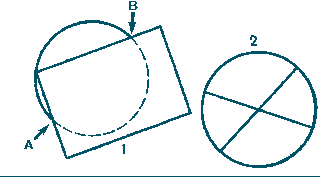 Here is an easy math trick to find the center of a circle.
Put the corner of a paper sheet on the circumference of the circle (Picture 1), then mark points A and B where the sides of the paper cross the circle. You may be sure that points A and B mark the ends of a diameter. Draw it. Then repeat this process at a different place to get another diameter (Picture 2). You will find the center where the two lines cross. |
Sum of all angles of a triangle
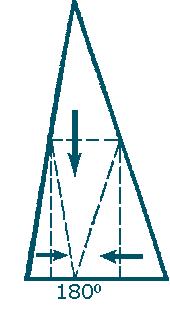 Do you remember how your teacher of geometry taught you to prove that the sum of all
the angles of a triangle is 180°? Yes, of course, you do. But it is interesting to prove it
in the following easy math trick.
Do you remember how your teacher of geometry taught you to prove that the sum of all
the angles of a triangle is 180°? Yes, of course, you do. But it is interesting to prove it
in the following easy math trick.
Cut a triangle out of a piece of paper. If you fold over the corners, as shown in the picture, you can easily make the three angles fit together to form a 180° angle at the base of the triangle. |
The Pythagorean theorem
 According to the famous Pythagorean theorem the square on the hypotenuse of a right-angled triangle
equals the sum of the squares on the other two sides. Here is a math trick to prove this theorem.
According to the famous Pythagorean theorem the square on the hypotenuse of a right-angled triangle
equals the sum of the squares on the other two sides. Here is a math trick to prove this theorem.
First draw the squares on the two shorter sides of any right-angled triangle. Divide the square on the larger of these sides into four parts by two lines at right angles to each other and crossing at the center of the square. One of these lines is parallel to the hypotenuse of the triangle. Now cut out the small square and the four parts of the larger one. You will find that these five pieces will fit together to form the square on the hypotenuse! Now, when you have done that easy math trick, can you prove it mathematically? |
Three cards
|
In some games you have more chances to win than you think you have. Imagine you have three cards:
one is black on two sides (BB), one is white on two sides (WW), and one is black on one side
and white on the other (BW). You put them in a hat, then take out a card and put it on the table.
What are the chances that the other side will be the same as the upper side? If the upper side
is black, you will perhaps think in the following way: "This can't be the WW card.
So, it may be the BB or the BW. The chances are the same."
But the chances are not the same. There are two chances that the other side is black too, and only one chance that the other side is white. There are three possible answers in this easy math trick, not two, as you thought. If the upper side is black, it maybe that:
|
